Project 1 - Style in Public Space
The first project of English 2W focuses on how to demonstrate a writing style in public writing contexts. Details about the project, deadlines, and point distribution are shared in this handout.
This is a working document. I will be adding content to it and/or tweaking the existing content, as my thought evolves on these assignments and as our discussion on rhetoric becomes more clarifying for me. The idea is to make the assignment expectations clearer to you and more relevant to the course.
Table of Contents
Project Description
For this project, you’ll analyze examples of public writing done by a range of professionals (educators, scientists, journalists, independent researchers, economists, etc.) and you’ll write a Substack-style newsletter of 1200 words or more. You’ll be expected to include multimodal contents (audio, video, charts, etc.) for this project.
Total grade points: 20%
Project Expectations
- Start with a topic idea that you’re passionate about. Questions to ask are: why are you creating this newsletter? What’s unique and important about it? Who is the audience? Check the “Topic Proposal” and “Outline” expectations below.
- Once you’ve established a newsletter idea, you’ll compose a post for it as part of Project 1. The idea is that this project will align with the overall theme/purpose of your newsletter and it will be about 1200 words or more. You can envision this post as the first post of your newsletter or second or third…The point is that the number of the post itself is less important and you can only make a passing reference to it. Importantly though, the post should focus on a single subject matter, problem, or issue.
- The structure of the essay should not be fragmented. By that I mean most of the Substack posts tend to have multiple sections to them, wherein the sections are not strictly related to them.
- For example, often in the Substack posts, authors discuss subscription-related issues or they’re promoting someone else’s work or they’re plugging something else. Avoid doing that in your post.
- Additionally, some other posts are structured in a highly fragmented way, in which the post is a collage or smorgasbord of a bunch of different topics. Avoid this type of structure to your post.
- Another style of Substack post is listicles, like this post titled “Why Persuasion Often Fails.” Avoid this type of structure too.
- So what type of structure will be more suitable for your post? Here are a few examples:
- I think Jenn McClearen’s post is a good model. It reads like an advice column but the work has a tight and purposeful structure to it. And an advising genre is a relevant context to experiment in style.
- Another example will be the post titled “The Power of Feeling Your Feelings” by Vasile Stănescu. It has a singular topical focus and the structure is more essayistic than disjointed. Though I must admit that section headers like the ones you’ll find in McClearen’s post are a crucial part of the newsletter genre.
- This post titled “Who’s Getting Rich Off Your Attention?” by finance expert Kyla Scanlon is on the longish side but makes great use of multimodal content. It dives deep into a contemporary economic issue and composes a very structured, informative and argumentative piece.
- Finally, Finally, the post titled “ADHD Is a Personality Trait, not a Disorder” by Peter Gray, the Psychology and Neuroscience scholar, is focused on a single topic and builds a coherent argument on that topic.
- Make sure that you’re incorporating multimodal content in your work. There’s no minimum number of contents to incorporate. But think of it in an organic manner. Ask yourself, for my topic, my argument, and my style, how should I design the “text” I’m producing. What diverse modes of communication (aural, visual, linguistic, gestural, and spatial) need to go into my communication to make my style and argument come across as substantive and emphatic.
- Multimodal contents need to have captions below them and their source needs to be cited.
- Also, for the textual content, citation is expected when necessary. Use the hyperlink method to cite your sources. You can see in the Substack posts how to hyperlink your source in a reader-friendly and intuitive manner.
Drafting and Grade Distribution
Total grade points: 20%, which is divided as follows:
- Topic proposal: Propose the topic on which your newsletter will be based by Feb 3. Follow the prompt in Moodle. Grade points will be 2%.
- Outline: Submit an outline for your newsletter post by Feb 8. Grade points: 2%. What I am looking for in this outline is:
- a) What’s special about your newsletter? Meaning, what’s the niche topic or exigency around which your newsletter is built? We’ll need to brainstorm more on this area, as this is the crucial first step to ensuring that you get clarity and purpose in exercising style.
- b) Who is the audience? What demographic or what sort of “public” for which this newsletter is targeted?
- c) What will be the structure of your post? Meaning, the outline will lay out the overall organization of your content.
- d) What sort of multimodal content will go into the post?
- Rough Draft: Submit the first 1000 words of your newsletter post by Feb 13. Rough draft carries 4% grade points. You’ll lose these points if you don’t submit your Rough Draft. It’s okay for the Rough Draft not to be fully developed idea-wise and content-wise, but that doesn’t mean that Rough Draft can contain too many typos and that it’s sloppily organized. Please give your love and care to it to make it look professional, even though content-wise it’s a work in progress.
- Peer Feedback: Please provide feedback to one of your peer’s rough draft by Feb 15. A questionnaire will be provided to structure and compose your feedback. Grade points: 2%.
- Final Draft: Final Draft must be submitted by Feb 22. It should be an interactive and multimodal newsletter post of 1200 words or more. Additionally, the draft should meet the expectations of the project listed above. You can exceed the word count if needed. The final work should be a published piece on the Notion template that I have provided you. You’ll submit to Moodle the published link of your final draft. Grade points: 10%.
Modalities of Submission
- You’ll submit the Topic Proposal, Outline, and Peer Feedback to Moodle as a docx or pdf file.
- The Rough Draft should be composed in the Notion template I will provide you. Your writing should autosave in the Notion itself and I would encourage you to compose directly in it so that you get a more immediate writing experience of composing interactive and multimodal content. However, it’s prudent to keep a back up of your work in a Google Doc file. Notion is around long enough, they’re reliable, and they’ll save your work in their cloud storage. Nevertheless, it’s a new app for you if you’re not used to it. Better to be safe than sorry. As far as submitting your Rough Draft is concerned,
- Please follow the instructions as per the section “Share [your work] with one person”. You’ll give full access to me and your peer reviewer by using our Swarthmore email ID.
- Also use the “Copy link” option to copy the link to your draft and upload that link to Moodle for easy access by me and your peer reviewer
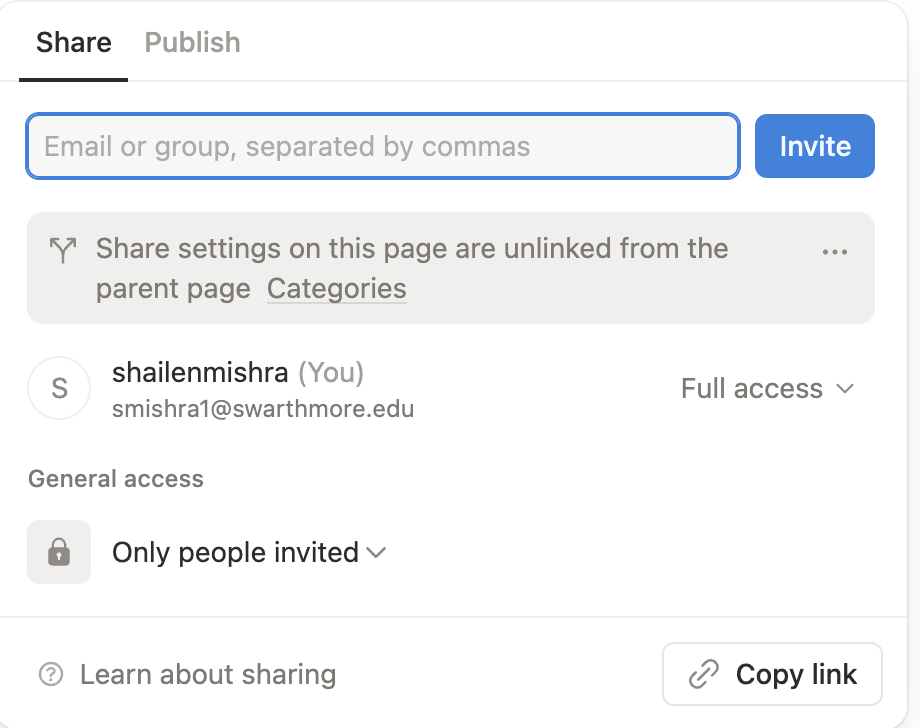
- The final draft should be published to the web. Follow the instructions in the section “Share with the web”. Copy the published link and post it to Moodle.
Notion Template
We will go over the following instructions in-person in class. So you can wait to follow these steps.
- Log in or create an account with Notion. Make sure that you create the account with your Swarthmore email ID that way you can upgrade to the Plus plan for free. Here are the instructions from their help page:
- Go to
Settingsin your sidebar. - Select
Upgrade plan. - Select
Get free education plan. If your school is recognized by our system, you’ll be upgraded automatically! - If you satisfy all requirements above for access to the plan but don’t see
Get free education plan, please write into [email protected] to request your school domain get access. If your institution is recognized by and listed in the WHED, your domain will be allowlisted and receive access.
- Go to
- Once logged in, head over to Words Matter Portfolio. Make a copy of this page: Move & duplicate content.
- This is a one-time copy. The page has multiple components which I will introduce you to in class. Essentially, this single page has links to multiple pages such as: Project 1 page, Project 2 page and Project 3 page. And these are the pages in which you’ll compose your drafts for each project. Also this copy will ensure that you start with a fresh copy of the pages and you become the sole owner of it. I and others won’t have access to any of these pages until you explicitly share it. Additionally, the page “Words Matter Portfolio” is meant to serve as a “single point” for showcasing your writing assignments to the class and the world.
Learning Outcomes
- Reading Skills: What readings in the class did resonate with you the most and why? What ways were you able to engage with the readings critically? How did the readings help you as a writer and rhetor? What persuasive and rhetorical strategies did you develop through the course readings?
- Writing Skills: What new writing skills did you learn or acquire? What new complexities and challenges did you tackle in your writing? What ways did your mental and emotional approach, voice, and style for the project vary? In what ways did you become aware of your writing process?
- Rhetorical Knowledge: How did the concept of rhetoric evolve for you in this project? What roles do you think emotion, culture and ecology play in shaping rhetoric? Who is the audience for this genre? What sort of audience knowledge is required? What’s the purpose of this genre? How did you apply ethos, logos, and pathos to make your argument more persuasive? What roles do you think context, audience, genre, culture, and emotions play in making rhetoric situation-specific?
- Metacognition: What strengths and weaknesses have you realized about yourself as a writer? What sort of critical and reflective thinking did go into your understanding of style? What stylistic aspects will transfer to future writing situations?
- Multimodal Literacy: What multimodal contents (audio, visual, etc.) did you read, research, compose, or incorporate for this project? How did the multimodal content choices enrich the persuasive appeal of your essay? How does emotion and multimodality work with each other in shaping rhetoric?
Student Questions
I expect you to have questions for me about the project. I’ll populate this section with your questions and my responses.